Why Local Billboards Make Small Businesses Look Bigger Than They Are
One local billboard can change how customers see your business. The psychology of physical advertising presence, and why it works so well for small businesses.
Big companies feel big because you see them everywhere: on buildings, on buses, on screens. A small business can be better at the actual job and still feel like it doesn't quite exist. That gap has nothing to do with quality. It's a visibility tax, and small businesses pay it.
One billboard closes that gap faster than almost anything else you can buy.
The Psychology of Presence
In 1968, psychologist Robert Zajonc showed something marketers have been cheerfully exploiting ever since: people like things more simply because they've seen them before. He called it the mere exposure effect. A 1989 meta-analysis by Bornstein confirmed it across 208 experiments. Familiarity breeds favourability, even when people can't remember seeing the thing at all.
That's why a billboard behaves differently from a banner ad. It's physically there, in someone's day. They drive past it. They see it from the bus. It stops being an ad and becomes scenery, which is exactly where you want to be.
Herbert Krugman's three-exposure theory maps the progression: the first exposure generates curiosity ("What is it?"), the second creates recognition ("I've seen that before"), and the third triggers decision-making. On a commuter route, that's Monday, Tuesday, Wednesday.
The Numbers
| Metric | Stat | Source |
|---|---|---|
| UK adults who see OOH advertising weekly | 98% | Route Research |
| Consumers who view DOOH favourably | 73% | OAAA/Harris Poll 2024 |
| Billboard brand recall | 55% | Nielsen |
| Digital banner brand recall | 21% | Nielsen |
| Online activations driven per ad spend (OOH vs average) | 4x | Nielsen |
| Consumers who noticed OOH in last 30 min before shopping | 83% | Outsmart |
| People who visited a business after seeing it on a billboard that week | 32% | Arbitron |
None of that is a hand-picked case study from a campaign that happened to go well. They're industry-wide figures, and they say physical advertising keeps beating digital on attention and recall.
Why Physical Beats Digital for Trust
MarketingSherpa found that out-of-home advertising is trusted by 69% of consumers, compared to just 25% for online pop-ups. That gap is enormous, and the reason is unglamorous: a billboard costs money, and everyone knows it. It reads as commitment. It says you're real and you're staying.
The Journal of Advertising Research has documented a "halo effect" where physical advertising presence lifts the perceived quality of the business itself. See a brand on a billboard and you quietly assume it's more established and more trustworthy than one you've only met in an Instagram feed. Slightly unfair. Very useful.
There's a blunter angle too: 42.7% of internet users globally run ad blockers. Your digital campaigns never reach any of them. Nobody has ever installed a blocker for a large lit rectangle by a roundabout.
"When you book a billboard campaign, you know when and where it will appear and that you'll have an audience: no ad blockers, fast-forwarding, bots, or fake clicks." Out of Home Advertising Association
What This Looks Like in Practice
The neighbourhood café. Books one digital screen on the high street near the morning commute route. Within a week, regulars say they "see it everywhere." New customers walk in with "I've been meaning to come in. I keep seeing your ad." The café hasn't changed at all. The perception has.
The local tradesperson. An electrician books a billboard near a residential estate. Now they're the electrician people recognise, rather than the fourth number down on Google. When a boiler goes, the name people have been driving past for two weeks is the one that gets the call.
The high street salon. Books a screen opposite the shopping centre entrance. It's been open for three years, and new customers start saying "Oh, you're new! I saw your billboard." Being visible did what three years of being good didn't.
None of these need a leap of faith. Outsmart research shows 83% of consumers recall seeing OOH advertising in the 30 minutes before making a purchase decision. Arbitron found 32% of people visited a business they'd seen on a billboard within that same week.
The proximity effect is real: billboards near your location turn passing awareness into foot traffic.
You Don't Need a Big Budget
Billboard advertising used to come with a sales call, a media buyer and a £5,000 minimum contract. It was a members' club and small businesses were not on the list. Self-service platforms took the door off:
- Book a single screen near your location from £20/day
- No minimum contracts: test with a day or a week
- AI design tools handle creative if you don't have a designer
- Instant booking: no sales team, no back-and-forth
Start with one screen in your immediate area. Pick the spot your customers genuinely pass, see billboard advertising prices, run it for a week. Then actually check: promo codes, "how did you hear about us", Google reviews mentioning the ad. If it does nothing, you're out the price of a takeaway and you know something.
One billboard on the right street does more for how big you look than a month of digital campaigns. Once people see you in the real world, you stop being a business they found online. You become part of the neighbourhood.
You don't have to be big to look big. You just have to be visible where it matters.
Related Articles
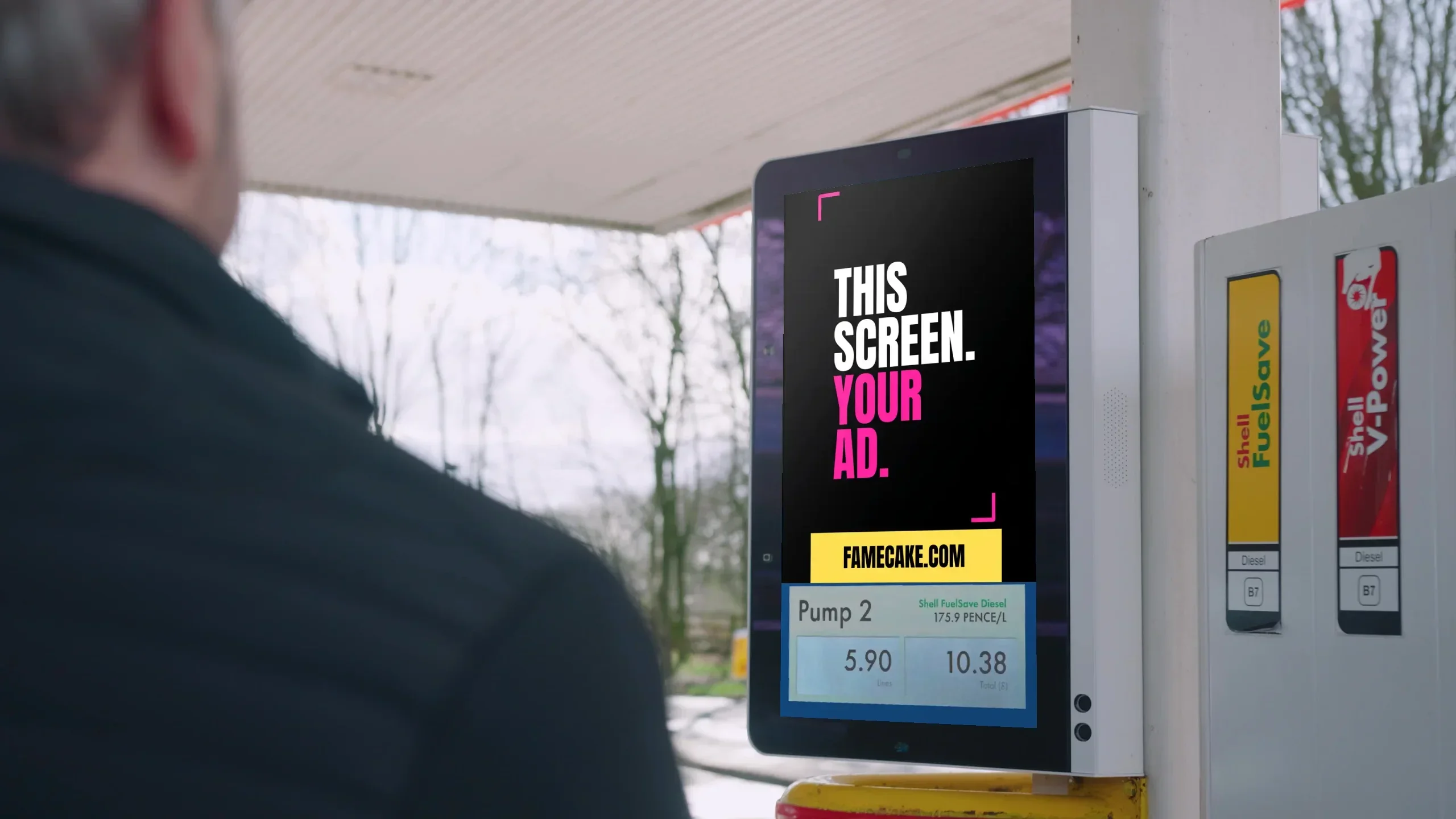
Shell Forecourt Advertising: A Whole Petrol Station for £30 a Day
Put your ad on a whole Shell petrol station forecourt for £30 a day. 89 forecourts, most with 6 to 12 screens, recently about 11,000 plays a day. Here are the real numbers.
UK Billboard Advertising Just Had Its Best Second Quarter Ever
UK outdoor advertising earned £402.6m in Q2 2026, up 12.7% and a record for the quarter. What drove it, and what it means for a small business with £20.
Are Manchester Billboards Really 45% Cheaper Than London? Real Prices (2026)
One trade piece says Manchester billboards cost 45% less than London. We compared real day rates on 160 screens. For small advertisers, the gap mostly disappears.