Estate Agent Billboard Advertising: Win Instructions in Your Patch
How estate and letting agents use digital billboards to win instructions and stay the name sellers see daily. Target postcodes from £10, live in minutes, no contract.
Every estate agent knows the awkward truth about winning instructions: the seller picks you before they ever call you. By the time they type "estate agents near me", they already have a shortlist in their head. Your job is to be on it. And the name people put on that list is usually the one they've been seeing around for months, on the boards, on the high street, on the drive to work.
A billboard is how you get on that list without waiting for a For Sale sign to do it for you.
The problem with waiting for boards
Boards are brilliant, but they have a flaw: you only get one when you've already won the instruction. They advertise the houses you're selling, not the houses you want to sell. In a quiet month with three boards up in a postcode, you're barely visible. Your competitor with eight boards looks like the busy agent, whether they are or not.
That's the visibility gap. Sellers assume the agent they see most is the agent selling most. It's not always true, but it's how people decide, and it quietly hands instructions to whoever looks biggest.
A billboard fills the gap between listings. When your boards are thin on the ground, a screen keeps your name in the postcode anyway. You stay the local agent even in a slow week.
- You only get one after winning the instruction
- Advertises houses you're selling, not ones you want
- A quiet month leaves you barely visible
- Fills the gap between listings
- Keeps your name in the postcode
- You stay the local agent in a slow week
Be the name sellers see daily
Homeowners don't decide to sell on a whim. They think about it for months, sometimes years. New baby, job move, kids gone, divorce, a nudge from the neighbour who just got a good price. Somewhere in that slow build-up, they start noticing estate agents. You want to be the one they've already noticed.
This is why frequency beats a single splash. A homeowner who passes your name on the school run every morning for six weeks has met your brand thirty times before they ever consider selling. By the time they do, you're not a cold Google result. You're the agent they "keep seeing".
Digital screens make that repetition cheap. You're buying a share of a screen's time near the homes you want to list, and your message rotates back every couple of minutes to everyone driving past.
Campaigns that actually win instructions
You don't need a clever slogan. You need the right message in the right postcode at the right moment.
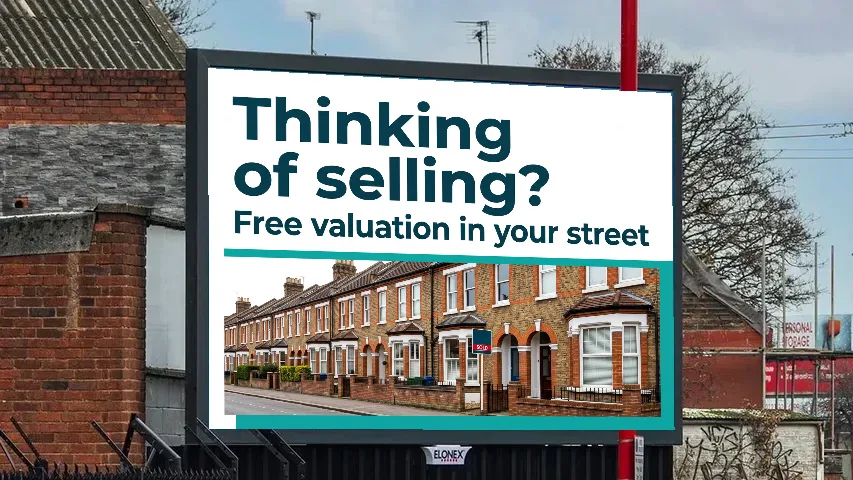
- "Thinking of selling?" The classic for a reason. It catches homeowners at the exact moment of consideration and gives them a name to call. Point it at residential streets, not the town centre.
- "Just sold in [street name]." Nothing signals a busy, effective agent like a recent local sale. Sellers on that street and the next one over will notice, and social proof does the persuading for you.
- "Free valuation this weekend." A direct call to action with a deadline. Good for filling the diary when instructions are slow.
- Letting agent version: "Landlords: your property let in 14 days." Target the postcodes with the rental stock you want to manage.
- Brand-only: just your name, your patch, your face. Sometimes being seen is the whole campaign.
The trick is matching the message to the area. A "thinking of selling?" screen means one thing near a street of family homes and nothing at all outside a retail park.
Vendor confidence: looking like the busy agent
Here's the part that pays for itself. When you pitch for an instruction, you're competing on the vendor's perception of how well you'll market their home. A seller who has watched your name on a billboard for weeks walks into that valuation already half-sold. You look established. You look like you spend on marketing, which means you'll spend on marketing their house too.
The Journal of Advertising Research has documented a "halo effect": physical advertising presence lifts how good people assume a business is, before they've dealt with it at all. Slightly unfair on the agent down the road. Very useful for you.
There's a blunter version of the same point. A billboard costs money, and everyone knows it. It reads as commitment. A vendor sees it and thinks: this lot are serious, they're staying, they've got budget. That's exactly the impression you want in the room.
Target the postcodes you actually want
The old way to advertise in a specific area was to ring a media owner, ask what was available, and wait for a quote. Digital self-service platforms skip all of that. You pick the screens on a map and see which streets and neighbourhoods they cover before you spend a penny.
That precision matters for an agent, because instructions are geographic. You don't want awareness across the whole city. You want to own three or four postcodes where the stock is the right price and the fees are worth having. Book the screens that cover those streets and ignore the rest.
- Concentrate on the roads your target sellers drive daily
- Skip the town-centre screens if your patch is residential
- Add a screen near a competitor's stronghold when you want to take share
- Run the campaign for weeks, not days, so frequency does its work
What it costs
This is where estate agents usually brace for a media-buyer conversation and a five-figure contract. There isn't one. Self-service digital screens are sold by the day, and you book them yourself.
| Approach | Rough cost | Notes |
|---|---|---|
| Traditional agency billboard | £500 to £5,000+ / week | Media buyer, 2-week minimum, quote required |
| Self-service, single screen | ~£10 to £15 per day | By size, no contract |
| A patch of 3 to 5 screens, a month | a few hundred pounds | Real local coverage |
No minimum spend, no contract, live in minutes. For the full picture on formats and city rates, see our billboard advertising cost guide. The short version: a month of steady presence across your core postcodes costs less than a single portal upgrade, and it works while you sleep.
You also don't need a designer. The AI design tool builds the advert from your logo and message, so a "thinking of selling?" campaign can be live before your next viewing. Check the live price per screen on the pricing page or browse screens near your branch to see what covers your patch.
Why this beats another portal boost
Portals put you in front of people already looking for a house. Billboards put you in front of people who haven't decided to sell yet, which is where instructions are actually won. A local billboard makes a small agency look bigger than it is, and that perception is the whole game when a vendor is choosing who to trust with their biggest asset.
Portal spend disappears the moment you stop paying. A month of being the name in the postcode leaves a residue: people remember you. When the neighbour finally decides to sell, you're the agent they've been driving past all summer.
Getting started
- Pick your patch: the three or four postcodes where you want instructions
- Choose the screens: book the ones covering those residential roads
- Keep the message simple: "Thinking of selling?" plus your name and number
- Run it for weeks: frequency is the point, not a one-day splash
- Measure it: ask new valuations how they heard of you, and watch which postcodes call
You don't need a contract, a media buyer, or a fortnight's lead time to be the estate agent your patch recognises. See how estate agents use FameCake, then browse the screens covering your area and put your name where the sellers are.
The agent who wins the instruction is usually the one the vendor already knew. Be the name they see on the way home.
Related Articles
Shell Forecourt Advertising: A Whole Petrol Station for £30 a Day
Put your ad on a whole Shell petrol station forecourt for £30 a day. 89 forecourts, most with 6 to 12 screens, recently about 11,000 plays a day. Here are the real numbers.
UK Billboard Advertising Just Had Its Best Second Quarter Ever
UK outdoor advertising earned £402.6m in Q2 2026, up 12.7% and a record for the quarter. What drove it, and what it means for a small business with £20.
Are Manchester Billboards Really 45% Cheaper Than London? Real Prices (2026)
One trade piece says Manchester billboards cost 45% less than London. We compared real day rates on 160 screens. For small advertisers, the gap mostly disappears.