How Local Shops Use Digital Billboards to Pull People Off the High Street
How independent shops, boutiques and gift shops use digital billboards to announce sales, move new stock and win the high street. Costs, tactics and examples.
Everyone who walks your high street passes real screens without thinking about it. They read the coffee price, the bus times, the big lit rectangle by the crossing. For years the only businesses on those screens were the ones with a marketing budget and a media buyer on speed dial. The shop three doors down never got a look in.
That has changed. A local shop can now put a message on the nearest screen for the price of a sandwich, and have it live before the kettle boils.
The problem with being a good shop nobody sees
You can have the best gift shop in town and still lose the sale to a website. The website has a budget. It follows people around Instagram. It shows up when they search. You have a window, a door, and whoever happens to look up while walking past.
That gap is not about quality. It is about being seen. A shop that is genuinely better can feel smaller simply because it is quieter. Digital billboards are one of the few things that close the gap fast, because they put you in front of the exact people already on your street.
We wrote more about that effect in why local billboards make small businesses look bigger. The short version: presence reads as scale, and one screen buys you presence.
- Has a budget
- Follows people around Instagram
- Shows up when they search
- In front of people already on your street
- Presence reads as scale
- One screen buys you presence
What shops actually put on a screen
Retail moves in weeks, not quarters. A digital screen keeps up because you change the message whenever you like, at no extra cost. No reprint, no reprinting bill, no waiting.
Here is what independent shops tend to run:
- A sale, on the day it starts. "20% off everything this weekend" hits harder on a screen 200 metres from your door than in an email nobody opened.
- New stock landing. Boutiques announce a new range or a designer drop the morning it hits the rails.
- Seasonal peaks. Christmas, Valentine's, Mother's Day, back-to-school. The weeks when foot traffic is already high and you want a bigger slice of it.
- Late-night or Sunday opening. Tell people you are open when they assume you are shut.
- Just being there. A gift shop that runs a friendly "we're on the corner of X street" post for a fortnight becomes the shop people recognise, not the one they walk past.
The point of a screen is timing. You react to the week you are actually having, not the campaign you planned a month ago.
What it costs
This is the part that used to end the conversation. Traditional out-of-home meant a £5,000 minimum, a two-week cycle and a form that said "speak to our team". Most shops took one look and went back to a chalkboard.
Self-service digital screens sell time by the day, so the maths is different:
| What you want | Rough cost |
|---|---|
| A single screen for a full day | ~£10 to £15 by screen size |
| A few days over a sale weekend | £30 to £100 |
| A handful of screens across town for a season | scale by the day |
VAT included, no contract, no minimum spend. You can run one screen for one day and stop. For the full picture across formats and cities, see our UK billboard advertising cost guide, or just check live prices on the screens near you.
How a shop gets a post live in minutes
You do not need a designer, an agency, or a clue about "DOOH" (the trade's word for a big telly by a road). The flow is short:
- Pick the nearest screens. Search screens near your shop and choose the ones your customers genuinely walk past.
- Make the post. Type a line of text, or let the AI designer build a proper advert from a photo of your window or your product. No Photoshop, no brief.
- Choose your dates. Just Saturday, the full sale week, or every market day this month. Your call.
- Pay and go live. It appears in minutes. Change the message whenever the offer changes.
Target matters more than budget. One screen on the street your customers actually use beats five screens across a town they never visit.
Competing with online, on your own turf
The internet is very good at reaching everyone and slightly worse at reaching the person standing outside your shop. That person is your best customer, and a screen on their route is a channel the big websites cannot easily buy in your patch.
A few things worth knowing:
- No ad blockers on a billboard. Roughly 43% of internet users run one. Nobody has ever installed a blocker for a screen by a roundabout.
- People remember it. Physical outdoor advertising posts far higher brand recall than a banner ad, and shoppers routinely recall seeing outdoor ads in the half hour before they buy.
- It reads as real. A shop on a screen looks established. Slightly unfair on the website, very useful for you.
None of this needs a leap of faith. Run one screen for a sale weekend, put a code or a "saw us on the big screen" line at the till, and count what walks in. If it does nothing, you are out the price of lunch and you know.
A few real-shaped examples
The boutique. Books one screen opposite the shopping centre for a Saturday, announcing a new arrivals rail. New faces come in saying they "saw it on the way over". The stock was always there. The screen told people the day it landed.
The gift shop before Mother's Day. Runs a screen on the high street for the week before, swapping the message from "gift ideas in store" to "open till 6 today, last-minute sorted" as the day nears. Same screen, different message, no extra cost.
The corner deli. Books the screen the office crowd passes on the way to Pret every Friday: today's special, up all day for the price of a couple of sandwiches. It books itself.
Where to start
If you run a shop, start with the boring, sensible version:
- One screen, your street. The spot your customers actually pass.
- One clear message. A sale, a new range, or your opening hours. You have seconds of attention, so spend them on one idea.
- A short run. A day or a sale weekend, not a month.
- Count it. A code at the till, a note of who mentions it, a look at footfall.
The barber with a tenner now buys the same screen the department store does. That is the whole idea.
Ready to put your shop on the high street's screens? See how retail shops use FameCake, or browse the screens nearest you and check the live price. No media buyer, no minimum, no fortnight's wait.
Prices are indicative 2026 UK self-service rates and vary by screen and location.
Related Articles
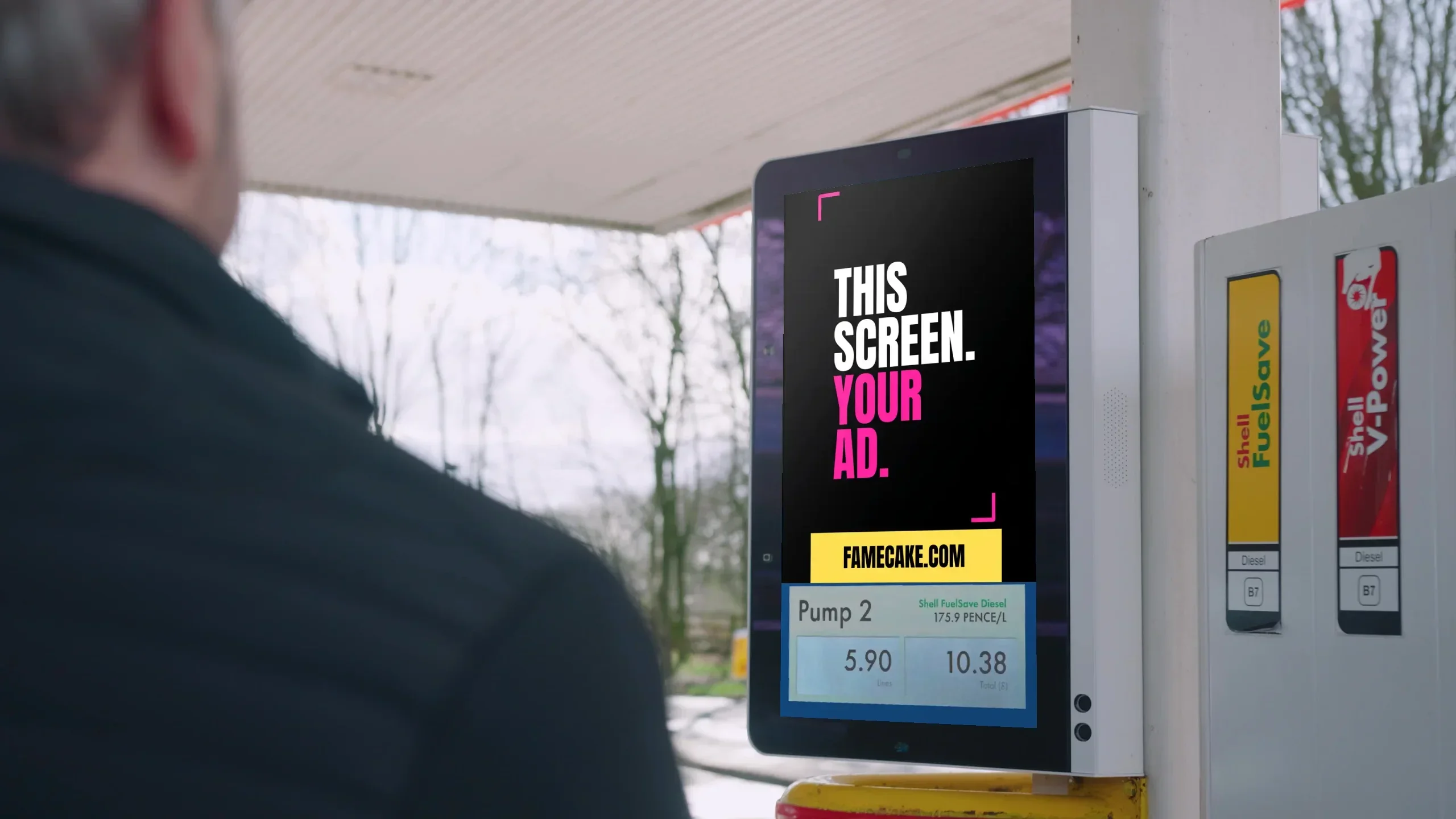
Shell Forecourt Advertising: A Whole Petrol Station for £30 a Day
Put your ad on a whole Shell petrol station forecourt for £30 a day. 89 forecourts, most with 6 to 12 screens, recently about 11,000 plays a day. Here are the real numbers.
UK Billboard Advertising Just Had Its Best Second Quarter Ever
UK outdoor advertising earned £402.6m in Q2 2026, up 12.7% and a record for the quarter. What drove it, and what it means for a small business with £20.
Are Manchester Billboards Really 45% Cheaper Than London? Real Prices (2026)
One trade piece says Manchester billboards cost 45% less than London. We compared real day rates on 160 screens. For small advertisers, the gap mostly disappears.