Is Billboard Advertising Worth It for a Local Business?
An honest answer to whether billboard advertising is worth it for a small business: who it works for, who it doesn't, and how to test it for the price of a takeaway.
Short answer: sometimes. Longer answer: it depends on what you sell, where your customers are, and whether you can measure the difference. Billboards are brilliant for some local businesses and a waste of money for others, and anyone who tells you it always works is selling you something.
We sell billboard time. We'd still rather you spent a tenner finding out than a fortune assuming. So here's the fair version.
When billboards are worth it
Billboards earn their keep when you have a physical catchment and people move through it. If your customers walk, drive or wait somewhere on their way to buying, a screen in that spot buys you the thing digital struggles to: repeated, unskippable presence in someone's actual day.
They work well if you're:
- A local business with a location. A café, salon, garage, gym or shop that people visit in person. The billboard and the front door are in the same catchment.
- After brand awareness in a specific area. You want the neighbourhood to know you exist and keep seeing your name until it feels familiar.
- Promoting an event, launch or offer. A new opening, a seasonal push, a one-week deal. Billboards are good at "this is happening, near you, now".
- Reaching commuters and shoppers. People on a route or in a retail park are a captive audience with nowhere to click away to.
The mechanism is boring and reliable. People trust things they've seen before, and they've seen your screen on Monday, Tuesday and Wednesday on the same commute. Nielsen puts billboard brand recall at 55%, against 21% for a digital banner. Nobody has ever installed an ad blocker for a large lit rectangle by a roundabout. We wrote more about why that presence works in how local billboards make small businesses look bigger.
When it's probably not worth it
Now the part most billboard sites skip. Some businesses should not book one, or at least not first.
Billboards suit you less if you're:
- Selling to a tightly defined niche. If your customer is "left-handed dentists in Surrey", a billboard sprays your budget at 50,000 people to reach the four you want. A targeted ad does that better.
- Running pure direct response. If you need to know exactly who clicked, when, and what they bought, a billboard won't give you that. It builds awareness, not a click log.
- Purely online with no local hook. If you ship nationwide from a spare room and location means nothing to your sales, a local screen is fighting with one hand tied.
- Working with no way to measure. If you can't tell whether anything changed, you'll never know if it worked, and you'll either quit a winner or keep feeding a loser.
If you need attribution down to the individual click, a big screen by a road is the wrong tool. We'd rather say that now than take your money and shrug later.
Worth it / maybe not, at a glance
| Worth it if... | Maybe not if... |
|---|---|
| You have a physical location or catchment | You're online-only with no local angle |
| Customers pass a specific route or area | Your audience is a tiny, scattered niche |
| You want awareness and recall | You need click-level conversion tracking |
| You're promoting an event, launch or offer | You can't measure the result at all |
| Footfall or drive-by traffic matters to you | Every sale must be tracked to a source |
Most local businesses sit on the left. If you're a restaurant, a hair and beauty place, a garage or a shop, you probably have a catchment and people moving through it. That's the profile billboards were built for.
How to actually measure it
"Did it work?" is a fair question and a hard one, because billboards do their job before anyone reaches a till. You can still get an honest read without a marketing degree.
- Promo codes. Put a code on the screen that only the billboard shows. Every use is one you can trace.
- "How did you hear about us?" Ask at the counter or on your booking form. Rough, but the pattern shows up fast.
- Brand searches. Watch your Google Business profile and branded search traffic during the run. A bump in people typing your name is the billboard working.
- Foot traffic and calls. Count walk-ins, bookings or phone calls week over week. You know your normal. Look for the lift.
None of this is perfect, and we won't pretend it is. Billboards are an awareness buy, and awareness is fuzzy. But "fuzzy" is not "unknowable". If three people this week mentioned the screen and your Saturday was busier than usual, that's signal, not noise.
The metric the industry likes is cost per thousand impressions (CPM), the price to put your message in front of a thousand pairs of eyes. Billboards typically land at £2 to £10, competitive with digital, and the eyes are attached to people rather than bots. We dig into the full numbers in the UK billboard advertising cost guide.
How to test it cheaply
Here's the bit that changes the whole "is it worth it" question. You used to have to bet big to find out. Booking a billboard meant a sales call, a media buyer, a two-week minimum and a £5,000 budget. It was a members' club, and small businesses weren't on the list. So the honest answer to "is it worth it" was "no idea, and finding out costs a car".
That's gone. Self-service digital screens sell time by the day, so you can test the theory for the price of a takeaway.
- Day rates of roughly £10 to £15 per screen, depending on size.
- No contract, no minimum spend. Book one screen, one day. Nobody makes you commit.
- Live in minutes, not a fortnight. No quote, no PDF, no "speak to our team".
- AI designer built in. No designer, no printing. Type what you want and it makes the advert.
- A sales call and a media buyer
- A two-week minimum
- A £5,000 budget
- About £10 to £15 per screen per day
- One screen, one day, no contract
- Live in minutes
So the smart move isn't "should I spend thousands on billboards?" It's "what happens if I put one screen on my high street for a week?" Pick the spot your customers genuinely pass. See the live price per screen before you commit. Run it for a week and watch your codes, your searches and your door.
If it does nothing, you're out the price of lunch and you've learned something real about your market. If the phone rings, you scale: add screens, add days, cover more of your catchment. Test on one, prove it, then grow. That's a decision you can make with actual evidence instead of a media buyer's optimism.
So, is it worth it?
For a local business with a catchment and a way to measure, usually yes, and now you can prove it without betting the quarter. For an online-only niche that needs click-level tracking, usually no, and we'd rather you kept your money.
The old way made this an expensive gamble. A single screen for a week has turned it into a cheap experiment. You don't have to believe us, and you shouldn't. Browse screens near you, put your business on one for a few days, and let the results settle the argument.
Test one screen. Scale only if it works. Find a screen near you and see live pricing in a couple of minutes.
Related Articles
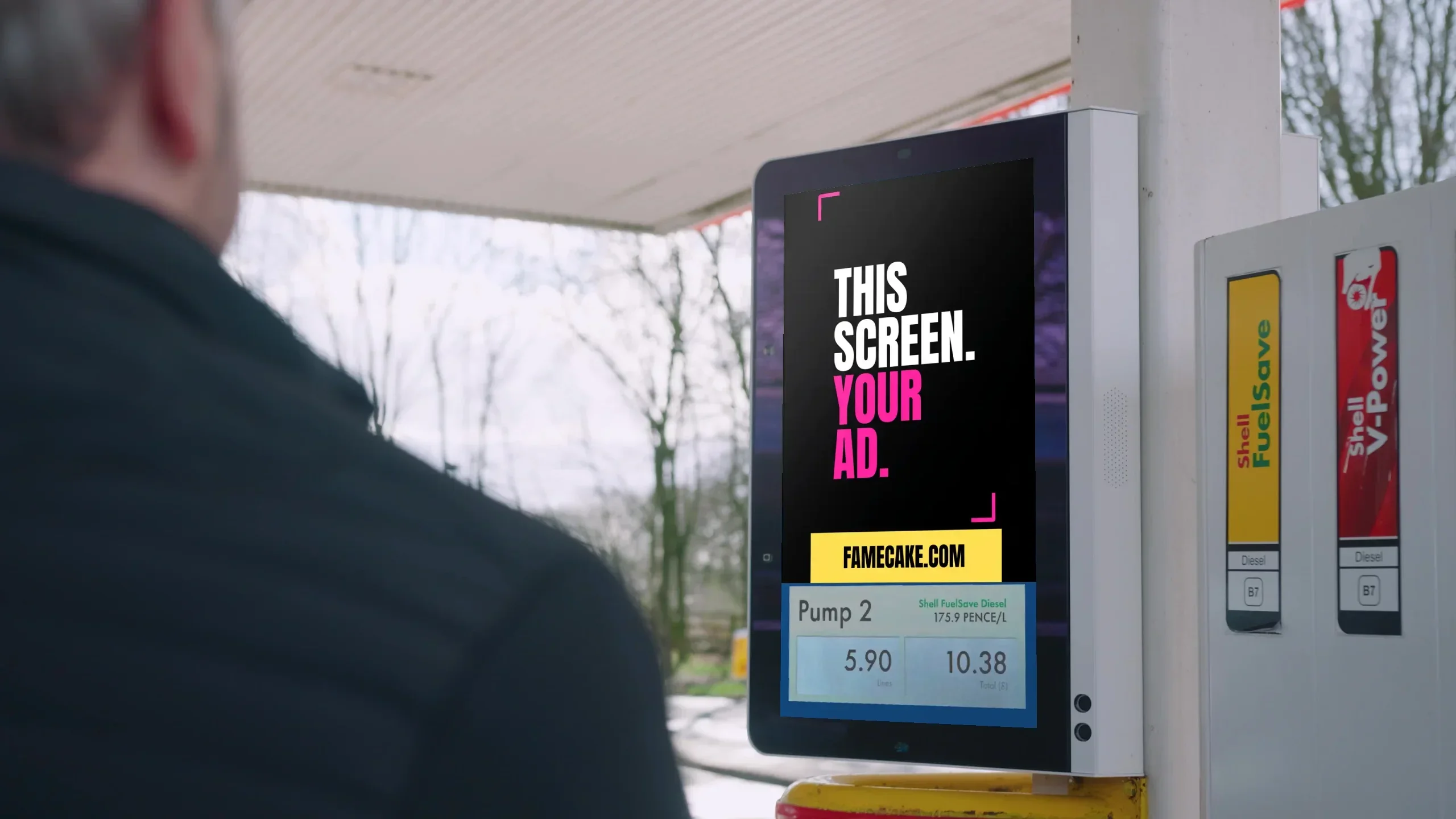
Shell Forecourt Advertising: A Whole Petrol Station for £30 a Day
Put your ad on a whole Shell petrol station forecourt for £30 a day. 89 forecourts, most with 6 to 12 screens, recently about 11,000 plays a day. Here are the real numbers.
UK Billboard Advertising Just Had Its Best Second Quarter Ever
UK outdoor advertising earned £402.6m in Q2 2026, up 12.7% and a record for the quarter. What drove it, and what it means for a small business with £20.
Are Manchester Billboards Really 45% Cheaper Than London? Real Prices (2026)
One trade piece says Manchester billboards cost 45% less than London. We compared real day rates on 160 screens. For small advertisers, the gap mostly disappears.